

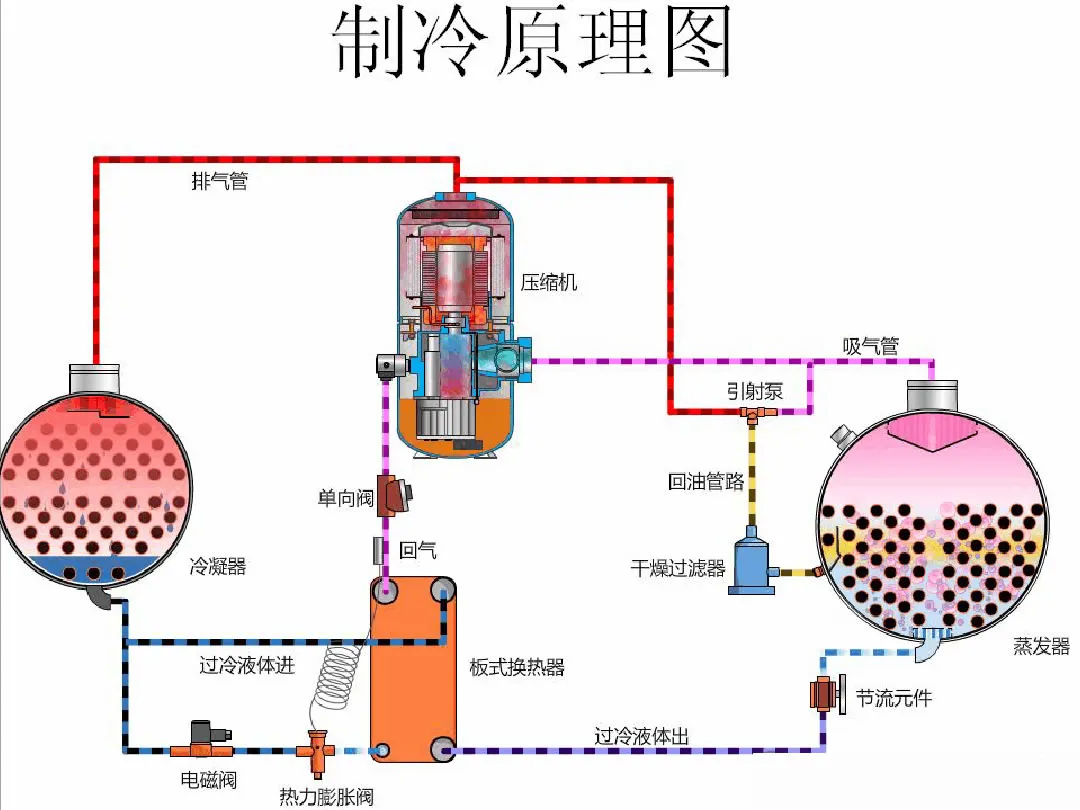
Refrigeration systems are an indispensable part of modern life, widely used in air conditioners, refrigerators, and other equipment. The normal operation of a refrigeration system relies on four core components: the compressor, condenser, evaporator, and expansion valve, as well as various auxiliary components. Each component plays an essential role in the refrigeration cycle. Below is a detailed introduction to the functions, classifications, and characteristics of these components.
1. Compressor
The compressor, as the heart of the refrigeration system, primarily compresses and transports the refrigerant. Through the compressor’s operation, the low-temperature, low-pressure refrigerant gas is transformed into a high-temperature, high-pressure gas. Based on different working principles, compressors can be divided into two main categories: positive displacement compressors and dynamic compressors.
Positive Displacement Compressors: These compressors compress the refrigerant by changing the volume of the working chamber. They include piston, screw, and rotary compressors. They can be further subdivided according to their structure into open, semi-hermetic, and hermetic compressors.
Dynamic Compressors: These compressors utilize the centrifugal force generated by high-speed rotation to compress the refrigerant. The most common type is the centrifugal compressor. This type of compressor is mainly used in large commercial and industrial systems.
For small to medium-sized commercial refrigeration systems, reciprocating (piston) compressors are the most commonly used; while in household refrigerators and air conditioners, scroll or rotary compressors are more frequently used. In addition, screw compressors are also widely used in large refrigeration systems due to their high efficiency and adaptability.
2. Condenser
The function of a condenser is to remove heat and cool the high-temperature, high-pressure gaseous refrigerant into a liquid state. It can be classified into three types based on the cooling medium used: water-cooled shell-and-tube condenser, air-cooled condenser, and evaporative condenser.
Water-cooled shell-and-tube condensers: These have high heat transfer efficiency due to the high internal water flow velocity, typically 1.8 to 3.0 m/s, which effectively removes heat. However, due to the higher resistance of the cooling water, cleaning is more difficult. This design is suitable for applications requiring efficient heat exchange and with sufficient water supply.
Air-cooled condensers: These rely on airflow for heat dissipation and are suitable for locations lacking sufficient water. They are generally used in small units with a cooling capacity not exceeding 60 kW, with a face wind speed of approximately 2.5 to 3.5 m/s. Compared to water cooling, its heat transfer coefficient is lower, approximately between 25 and 50 W/(m²·Kelvin).
To maintain good performance, condensers require regular cleaning to remove accumulated dirt. Common cleaning methods include physical scrubbing, mechanical scraping, and chemical treatment. Chemical cleaning, in particular, can dissolve scale and other deposits using specially formulated solutions, ensuring long-term stable operation.
3. Evaporator
The evaporator is the part of the refrigeration system responsible for absorbing heat, lowering the ambient temperature through the vaporization of the refrigerant. Depending on the object being cooled, evaporators can be divided into two types: those cooling liquid refrigerants (such as water or brine) and those cooling air.
Evaporators cooling liquid refrigerants: For example, horizontal shell-and-tube evaporators (dry evaporators), where the refrigerant evaporates inside the tubes while chilled water flows on the outside. These evaporators are characterized by a high refrigerant mass flow rate inside the tubes, typically between 180 and 200 kg/(m²·s), and a large number of flow paths to ensure sufficient contact.
Evaporators cooling air: These evaporators are commonly used in direct-evaporation air coolers, installed in split-type air conditioners or other similar equipment. They are equipped with fins to enhance heat exchange efficiency and have internal distributors to evenly distribute the refrigerant.
4. Expansion Valve
The expansion valve is a crucial valve for precisely regulating refrigerant flow and also acts as a throttling element. It automatically adjusts its opening based on evaporator pressure changes to maintain appropriate superheat. The expansion valve not only effectively controls refrigerant flow but also handles cooling and throttling. Proper installation and maintenance of the expansion valve are essential for ensuring the stability and energy efficiency of the entire refrigeration system.
5. Receiver
Located after the condenser and before the expansion valve, the receiver’s main function is to compensate for fluctuations in the condenser liquid level caused by load changes. When the expansion valve opens or closes, the liquid level in the condenser changes; without the additional refrigerant supplied by the receiver, insufficient liquid may occur before the expansion valve, affecting its operational stability. Furthermore, the receiver also acts as a separator, helping to separate liquid refrigerant from vapor, ensuring that only pure liquid refrigerant enters the expansion valve.
6. Oil Separator
During compressor operation, some lubricating oil is inevitably carried away, which can affect the internal lubrication of the compressor and reduce its lifespan. Therefore, an oil separator is installed in some refrigeration systems to address this issue. An oil separator effectively separates lubricating oil from the discharged high-temperature, high-pressure gas and returns it to the compressor via a built-in control system. This prevents mechanical wear caused by insufficient oil and avoids the problem of excessive lubricating oil entering subsequent processes and reducing overall heat exchange efficiency.
7. Solenoid Valve
A solenoid valve is a valve controlled by electromagnetic force and is widely used in various types of refrigeration equipment. Depending on the application, it can be normally closed (NC) or normally open (NO). When the refrigeration cycle needs to be started, the temperature sensor detects that the temperature has risen to the set value, the power terminal is connected, and the solenoid valve opens to allow refrigerant to flow into the evaporator; conversely, when the temperature drops below the preset point, the solenoid valve is de-energized and closes, preventing more refrigerant from flowing into the evaporator, thereby regulating the temperature inside the refrigerator compartment.
8. Pressure Controller
To protect the compressor and other critical components from damage caused by excessively high or low pressure, a pressure controller is usually installed in the system. Single-pressure controllers come in two types: low-pressure controllers and high-pressure controllers, used to monitor the pressure levels on the evaporator side (low-pressure side) and condenser side (high-pressure side), respectively. Dual-pressure controllers integrate both functions. Upon detecting an abnormality, such as excessively low intake pressure or excessively high exhaust pressure, the pressure controller will cut off the power to stop the compressor, thus ensuring the safety of the entire system.
9. Dryer Filter
The dryer filter is a crucial component used to remove moisture and other impurities from the refrigerant. The presence of moisture can cause ice blockage, especially when using capillary tubes as throttling devices. It also accelerates the corrosion process of metal pipes and fittings, shortening equipment lifespan. Therefore, adding a dryer filter to the refrigerant circuit is essential.
10. Sight Glass
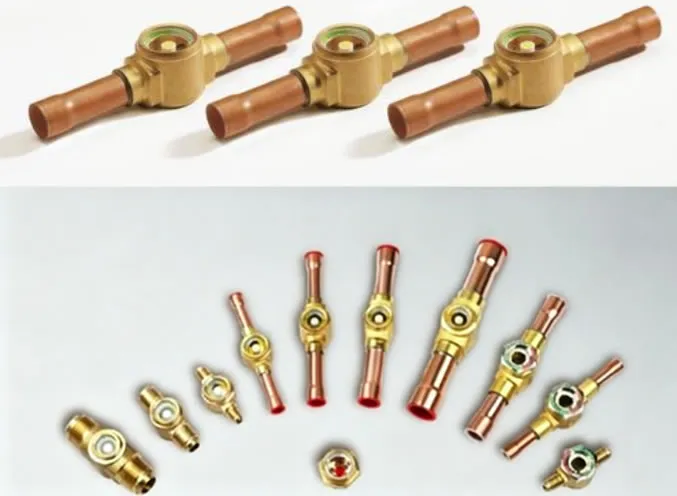
The sight glass is installed on the refrigerant piping for visual inspection of the refrigerant’s condition. Through the transparent glass, one can see if bubbles are forming and if the refrigerant color has changed. This provides direct evidence for determining if there are leaks in the system and whether refrigerant needs to be added.
11. Gas-Liquid Separator
A gas-liquid separator is typically installed before the compressor inlet. Its main function is to prevent liquid from directly entering the compressor and causing liquid slugging. Liquid slugging can severely damage the compressor, even leading to its complete failure. By using a gas-liquid separator, gas and liquid are effectively separated, ensuring that only gas is drawn into the compressor, thus protecting its safety.
12. Temperature and Pressure Sensors
To achieve more precise control and monitoring, various types of sensors are used. Temperature sensors measure temperature changes at different locations, such as evaporator outlet temperature and condenser inlet temperature; while pressure sensors monitor the pressure conditions on the high-pressure and low-pressure sides. The data collected by these sensors is fed back to the control system, helping to optimize operating parameters and respond promptly to any potential problems.
13. Controller/PLC
These devices are responsible for receiving information from various sensors and making corresponding decisions, such as starting/stopping the compressor, adjusting fan speed, and controlling solenoid valve switching.
14. Safety Valve
As the last line of defense, a safety valve automatically opens to release excess pressure when the internal pressure of the system exceeds a certain limit, preventing explosions. These valves typically have a preset pressure threshold; when the actual pressure reaches or exceeds this value, the valve opens rapidly and closes again only after the pressure returns to normal.
In summary, a complete refrigeration system is not merely a simple combination of the four core components, but also includes a series of carefully designed and supporting auxiliary components. Every detail reflects the engineers’ focus on efficiency, reliability, and user experience. Understanding the functions of these additional components and their interrelationships helps us better understand the entire refrigeration process and provides guidance for daily maintenance. By studying these components, we can gain a more comprehensive understanding of refrigeration technology, thereby improving our professional knowledge in related fields.

WeChat
Scan the QR Code with wechat